Table of contents
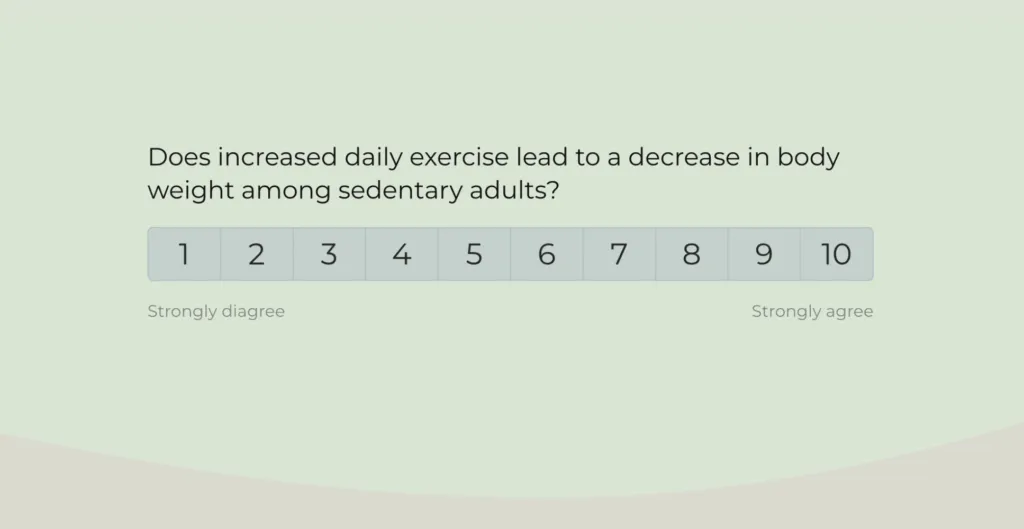
Formulating a solid hypothesis is the bedrock of any scientific research or data analysis. Whether you are designing a market research survey or conducting an academic study, the way you frame your prediction determines the statistical tests you use and the conclusions you can draw. Understanding the difference between a directional hypothesis and a non-directional hypothesis is essential for any researcher. In this comprehensive guide, we break down the critical differences between directional hypothesis and non-directional hypothesis, explain when to use each, and show you how to apply them to build better surveys and get more actionable data.
What is a Hypothesis in Research?
Before diving into the types, let’s define what a hypothesis is. A hypothesis is a testable statement about the relationship between two or more variables. It acts as a tentative answer to your research question, which you will aim to support or refute through data collection and analysis.
In hypothesis testing, we usually work with two opposing statements:
- Null Hypothesis ($H_0$): States that there is no effect or no difference.
- Alternative Hypothesis ($H_1$ or $H_a$): States that there is an effect or a difference.
The choice between a directional and non-directional hypothesis relates specifically to how you frame the Alternative Hypothesis.
Understanding Directional Hypothesis
A directional hypothesis (also known as a one-tailed hypothesis) predicts the specific direction of the relationship or difference between variables. It doesn’t just say that an effect exists; it specifies whether the effect is positive or negative, greater or smaller.
When to Use a Directional Hypothesis?
You should use a directional hypothesis when:
- Previous Research Exists: Past studies strongly suggest a specific outcome.
- Theoretical Basis: There is a logical theory explaining why the relationship should move in a certain direction.
- Specific Goal: You are implementing an intervention (e.g., a training program) and specifically want to test if it improves performance (testing for a decrease is not relevant).
Examples of Directional Hypotheses
- “Employees who receive a bonus will have higher job satisfaction than those who do not.”
- “Website A converts better than Website B.”
- “Increased screen time leads to a decrease in sleep quality.”
In statistical terms, a directional hypothesis allows you to use a one-tailed test. This puts the entire critical region (the area where you reject the null hypothesis) on one side of the distribution, making it easier to detect a statistically significant effect in that specific direction. However, it blinds you to effects in the opposite direction.
Understanding Non-Directional Hypothesis
A non-directional hypothesis (also known as a two-tailed hypothesis) predicts that there is a difference or relationship between variables but does not specify the direction. It simply states that Group A is different from Group B, or that Variable X correlates with Variable Y.
When to Use a Non-Directional Hypothesis?
You should use a non-directional hypothesis when:
- Exploratory Research: You are exploring a new topic with little prior evidence.
- Contradictory Findings: Previous studies show mixed results (some positive, some negative).
- Objectivity: You want to be conservative and test for any possibility of difference, regardless of whether it is positive or negative.
Examples of Non-Directional Hypotheses
- “There is a difference in job satisfaction between employees who receive a bonus and those who do not.”
- “Website A and Website B have different conversion rates.”
- “There is a relationship between screen time and sleep quality.”
In statistics, this requires a two-tailed test. The critical region is split between both ends of the distribution (e.g., the top 2.5% and bottom 2.5%). This makes it harder to reach statistical significance compared to a one-tailed test, but it is safer because it accounts for effects in both directions.
Key Differences: Directional vs Non-Directional Hypothesis
To help you choose the right approach, here is a comparison of the two types of hypotheses.
| Feature | Directional Hypothesis (One-tailed) | Non-Directional Hypothesis (Two-tailed) |
|---|---|---|
| Prediction | Specifies the direction (e.g., higher, lower, positive, negative). | States a difference exists but not the direction. |
| Statistical Test | One-tailed test. | Two-tailed test. |
| Statistical Power | Higher power to detect an effect in the predicted direction. | Lower power (requires a stronger effect to be significant). |
| Risk | Misses effects in the opposite direction (Type I error risk if assumptions are wrong). | More conservative; detects effects in either direction. |
| Best For | Confirmatory research with strong theory. | Exploratory research or conflicting evidence. |
| Key Terms | Increase, decrease, less, more, positive, negative. | Difference, relationship, association, change. |
The Role of Hypotheses in Survey Research
In survey research, hypotheses guide every step of the process, from question design to data analysis. Whether you are conducting a customer satisfaction survey or an employee engagement study, having a clear hypothesis ensures your survey asks the right questions.
1. Objective-Driven Surveys
A clear hypothesis helps you focus. If your hypothesis is “Longer customer support wait times lead to lower NPS scores,” you know exactly what to measure: wait times and NPS. You won’t waste respondents’ time with irrelevant questions.
2. Question Design
- For Directional Hypotheses: You might use Likert scale questions that allow respondents to express degrees of agreement (e.g., “Strongly Agree” to “Strongly Disagree”) to capture the intensity of the direction.
- For Non-Directional Hypotheses: You might include more open-ended questions or broader survey question types to capture unexpected patterns.
3. Data Analysis with Responsly
Modern survey tools like Responsly allow you to test these hypotheses effectively—you can even draft the whole questionnaire with the AI survey generator, which helps in-house research teams reduce research cost while keeping insight quality high.
- Cross-Tabulation: You can compare groups (e.g., trained vs. untrained employees) to see if the differences match your prediction.
- Correlation Analysis: Check if two variables move together as predicted.
- AI-Driven Insights: Responsly’s AI agent and feedback analytics can help identify patterns you might have missed, supporting exploratory (non-directional) analysis.
Examples of Research Questions and Hypotheses
Here are practical examples of how to translate research questions into both types of hypotheses.
Example 1: Education
Research Question: Does a new teaching method affect student test scores?
- Directional: The new teaching method improves student test scores compared to the standard method.
- Non-Directional: There is a difference in test scores between students using the new method and those using the standard method.
Example 2: Marketing
Research Question: How does email personalization affect click-through rates (CTR)?
- Directional: Personalized emails result in a higher CTR than generic emails.
- Non-Directional: Personalized emails and generic emails have different CTRs.
Example 3: Health
Research Question: Does a specific diet impact cholesterol levels?
- Directional: The low-carb diet reduces cholesterol levels.
- Non-Directional: The low-carb diet has an effect on cholesterol levels (it could increase or decrease them).
Summary
Choosing between a directional and non-directional hypothesis is a strategic decision in research design.
- Choose a Directional Hypothesis when you are confident in the expected outcome based on theory or past data.
- Choose a Non-Directional Hypothesis when you are exploring a new area or want to remain unbiased regarding the outcome.
Regardless of which you choose, the key is to test it with reliable data. Responsly provides the tools you need to create professional surveys, collect high-quality data, and analyze the results to prove or disprove your hypotheses.
Ready to put your hypothesis to the test? Sign up for free and start gathering data today.