Table of contents
- Key takeaways
- What is Employee Experience (EX)?
- Employee Experience vs. Engagement, Satisfaction, and Employer Branding
- Why Employee Experience Matters More Than Ever
- The Employee Experience Journey
- The Three Pillars of Employee Experience
- The Employee Experience Maturity Model
- Building Your Employee Experience Strategy
- Who Owns Employee Experience?
- Essential Employee Experience Metrics
- Common Employee Experience Mistakes
- Technology and Tools for Employee Experience
- Where Employee Experience Is Heading
- Getting Started: Your EX Action Plan
- Conclusion

Employee experience (EX) is the sum of everything an employee thinks, feels, and does across their entire relationship with your organization—and it has become the defining factor in attracting, retaining, and empowering top talent. In today’s competitive job market, salary alone doesn’t cut it—employees want meaningful work, growth opportunities, and a workplace that values their wellbeing. But here’s the part most EX guides skip: the companies that win at employee experience aren’t the ones that measure the most—they’re the ones that act fastest on what they hear. This guide covers the full picture—the three pillars, the six-stage journey, the metrics that matter—and then goes further: an EX maturity model to locate exactly where your program stands, and how AI-driven listening closes the gap between a survey result and a real fix.
Key takeaways
- Definition: employee experience is everything a person encounters in your organization—from the job ad, through recruitment, onboarding and growth, to offboarding.
- Three pillars: experience is shaped by culture, the technology people work with, and the physical (or remote) workspace.
- EX is the cause, engagement is the effect: you design experience and you measure engagement with a survey.
- Recruitment is part of EX: the experience starts before day one, so candidate experience and employee experience belong in the same plan.
- Measurement: a workable starter set is eNPS, satisfaction, voluntary turnover, time to productivity, and survey response rate.
- Speed beats sophistication: the differentiator is not how much you measure but how fast you act on what you hear.
What is Employee Experience (EX)?
Employee experience is the sum of all interactions, perceptions, and emotions an employee has with your organization—from the moment they see your job posting to long after they’ve moved on.
Unlike employee engagement (which measures emotional commitment), EX encompasses the entire journey:
- Attract: How candidates discover and perceive your employer brand
- Recruit: The application, interview, and offer process
- Onboard: First days, weeks, and months in the role
- Develop: Learning, growth, and career progression
- Retain: Ongoing experience, recognition, and support
- Exit: Offboarding and alumni relationships
Every touchpoint contributes to the overall experience—your careers page, onboarding process, manager relationships, office environment, technology tools, and even how you say goodbye.
Employee Experience vs. Engagement, Satisfaction, and Employer Branding
These four terms get used interchangeably, but they describe different things. Employee experience is the broadest and the most upstream—it is what shapes the other three.
| Concept | What it describes | Scope | How to check it |
|---|---|---|---|
| Employee experience | Everything an employee encounters across the lifecycle | From job ad to offboarding | Touchpoint map + surveys at every stage |
| Engagement | Emotional commitment and discretionary effort | Current state of the team | Engagement survey, eNPS |
| Satisfaction | Contentment with conditions and work environment | Current state of the team | Satisfaction survey |
| Employer branding | The promise you communicate to candidates externally | Labour market | Candidate experience surveys, review sites |
Engagement and satisfaction are indicators—they tell you the state of the team today. Employee experience is the lever you actually pull to move them.
Why Employee Experience Matters More Than Ever
The business case for EX rests on a well-documented link between how people experience work and how the business performs. Gallup’s meta-analysis of business units worldwide found that those in the top quartile for engagement are around 21% more profitable than those in the bottom quartile, alongside lower absenteeism and lower turnover.
The cost side is just as concrete. Replacing an employee typically costs a substantial share of their annual salary once you count recruitment, lost productivity, and ramp-up time—SHRM puts it at a significant fraction of annual compensation, and higher for specialist roles. Every avoidable resignation is that cost paid twice: once to replace the person, once in the output you lost while the seat was empty.
In the era of remote work, quiet quitting, and persistent competition for skilled people, employee experience isn’t optional—it’s how you keep the talent you already paid to hire.
Key Insight: Employee experience directly impacts customer experience. Happy employees create happy customers, which drives business results.
The Employee Experience Journey

The easiest way to plan employee experience is to break it into lifecycle stages. Each one has a different research question and a different measure of success.
| Stage | Key question | Survey | Metric |
|---|---|---|---|
| Attraction | Does our employer brand match the reality inside? | Candidate sourcing and brand perception research | Offer acceptance rate, quality of applicants |
| Recruitment | Was the process clear and respectful of the candidate’s time? | Candidate experience survey | Offer acceptance rate, candidate NPS |
| Onboarding | Does the new hire know what to do and who to ask? | 30- and 90-day surveys | Time to productivity |
| Development | Can people see a path and do they get feedback? | Post-training survey, 360 feedback | Training participation, internal mobility |
| Retention | Do conditions and relationships keep people here? | Engagement survey, pulse surveys | eNPS, voluntary turnover |
| Exit | Why do people leave and what can be fixed? | Exit survey | Recurring reasons for leaving |
Stage 1: Attraction
Before candidates even apply, they’re forming impressions of your company:
Key Touchpoints:
- Employer branding and careers page
- Job descriptions and postings
- Social media presence
- Glassdoor and LinkedIn reviews
- Employee referrals and word of mouth
Questions to Ask:
- Does our employer brand reflect our actual culture?
- Are job descriptions clear and appealing?
- What do current employees say about us online?
Stage 2: Recruitment
The hiring process reveals a lot about how you treat people:
Key Touchpoints:
- Application process simplicity
- Communication throughout hiring
- Interview experience
- Offer and negotiation
- Pre-boarding communication
Best Practices:
- Respond to all applicants (even rejections)
- Keep candidates informed of timeline
- Make interviews a two-way conversation
- Provide feedback when possible
Learn more about avoiding candidate experience mistakes.
Stage 3: Onboarding
Onboarding sets the tone for the entire employment relationship:
Key Touchpoints:
- First day experience
- Equipment and access setup
- Introduction to team and culture
- Training and resources
- 30/60/90 day check-ins
Why it matters: the first ninety days set expectations for everything that follows. A structured onboarding shortens time to productivity and turns initial enthusiasm into commitment; an improvised one leaves new hires guessing, and a gap between what was promised at interview and what they find on day one is one of the most common causes of first-year resignations.
Stage 4: Development
Employees want to grow—not just do the same job forever:
Key Touchpoints:
- Learning and development opportunities
- Career path clarity
- Skill-building programs
- Mentorship and coaching
- 360-degree feedback
Best Practices:
- Create clear career ladders
- Offer both vertical and lateral growth
- Invest in continuous learning
- Provide regular development conversations
Stage 5: Retention
Keeping great employees requires ongoing attention:
Key Touchpoints:
- Day-to-day work experience
- Manager relationships
- Recognition and rewards
- Compensation and benefits
- Work-life balance support
Warning Signs of Disengagement:
- Decreased productivity
- Withdrawal from team activities
- Increased absenteeism
- Lack of initiative
- Negative attitude
Learn strategies to reduce employee turnover.
Stage 6: Exit
How you handle departures impacts remaining employees and your employer brand:
Key Touchpoints:
- Resignation response
- Notice period experience
- Knowledge transfer
- Exit interviews
- Alumni relationships
Conducting thorough exit surveys provides valuable insights for improving EX.
The Three Pillars of Employee Experience
Jacob Morgan, author of The Employee Experience Advantage, identifies three environments that shape every employee’s experience regardless of company size. It is a useful frame because it shows that EX is not solely an HR topic.
1. Culture
Culture is the invisible force that shapes how work gets done. It includes:
- Leadership style: How managers lead and communicate
- Values: What the organization truly prioritizes (not just what’s on the wall)
- Purpose: Why the work matters beyond profit
- Psychological safety: Whether employees can speak up without fear
- Recognition: How achievements are celebrated
- Inclusion: Whether everyone feels they belong
Culture is what employees experience when no one is watching. It’s the atmosphere you feel when you “walk through the door”—whether physical or virtual.
2. Technology
The tools employees use daily profoundly impact their experience:
- Collaboration tools: How teams communicate and work together
- HR systems: Ease of requesting time off, accessing benefits, giving feedback
- Work equipment: Quality of laptops, software, and tools
- Automation: Reducing tedious manual tasks
- Mobile access: Working from anywhere seamlessly
Nothing frustrates employees more than fighting with outdated technology. Modern tools signal that you value their time and productivity.
3. Physical Workspace
The environment where work happens—whether office, home, or hybrid:
- Office design: Open spaces, quiet areas, collaboration zones
- Amenities: Cafeterias, gyms, relaxation spaces
- Remote work support: Home office stipends, equipment, policies
- Flexibility: Choice in where and when to work
- Health and safety: Clean, comfortable, ergonomic spaces
Read more about employee work-life balance and its impact on experience.
If your EX program only covers the first pillar, you will most likely spend your time fighting symptoms rather than causes.
The Employee Experience Maturity Model
Most organizations don’t have an “EX problem”—they have a speed-to-action problem. They collect feedback but take weeks or quarters to respond, by which point the disengaged employee has already mentally checked out. Before building a strategy, find your current stage below, because your next move depends entirely on where you actually are today.
| Maturity stage | What it looks like | How you listen | Biggest risk | Next move |
|---|---|---|---|---|
| 1. Reactive | EX is HR’s job; you act after someone resigns | One annual engagement survey | You only learn why people left in the exit interview | Add a recurring pulse and an eNPS baseline |
| 2. Structured | Regular cadence, dashboards, some manager reviews | Quarterly pulse + eNPS | Survey fatigue with slow follow-up erodes trust | Close the loop publicly within 2 weeks of each survey |
| 3. Continuous | Always-on listening across the whole journey | Lifecycle + pulse surveys, onboarding & exit surveys | Too much data, not enough analysis capacity | Automate theme detection on open-ended answers |
| 4. Predictive (AI-driven) | Feedback drives decisions in near real time | Continuous listening + AI analysis of verbatims | Over-reliance on scores without human judgment | Pair AI insights with manager coaching |
Choose your focus by stage: if you’re at stage 1–2, invest in cadence and closing the loop—consistency beats sophistication. If you’re at stage 3–4, the bottleneck is rarely collecting more feedback; it’s turning thousands of open-ended comments into decisions fast enough to matter. That analysis layer is where AI changes the game (more on that below).
Building Your Employee Experience Strategy

A comprehensive EX strategy requires commitment from leadership and alignment across the organization:
Step 1: Understand Your Current State
Before improving, you need to know where you stand:
- Conduct surveys: Use pulse surveys and annual engagement surveys
- Analyze data: Review turnover, exit interviews, and performance metrics
- Listen actively: Hold focus groups and one-on-ones
- Map the journey: Document current experience at each stage
- Benchmark: Compare against industry standards
Step 2: Define Your EX Vision
Create a clear picture of what great EX looks like for your organization:
- Align with company values and culture
- Make it specific and measurable
- Involve employees in defining it
- Get leadership buy-in and sponsorship
Step 3: Identify Priority Areas
You can’t fix everything at once. Focus on:
- High impact: Changes that affect many employees significantly
- Quick wins: Easy improvements that build momentum
- Pain points: Areas with the most negative feedback
- Strategic priorities: Aligned with business goals
Step 4: Design Interventions
For each priority area, design specific improvements:
Example: Improving Onboarding
- Create structured 90-day onboarding program
- Assign dedicated buddies to new hires
- Implement weekly check-ins with managers
- Build comprehensive self-service resources
- Send welcome packages before day one
Step 5: Empower Managers
Managers have the biggest impact on employee experience:
- Train managers on EX principles
- Provide tools for regular feedback
- Hold managers accountable for team engagement
- Support manager development
Step 6: Measure and Iterate
EX is never “done”—it requires continuous improvement:
- Track metrics consistently over time
- Act on feedback promptly
- Communicate changes back to employees
- Celebrate wins and learn from failures
Who Owns Employee Experience?
Managing employee experience means coordinating everything that shapes how people perceive the organization—HR processes, IT tooling, workspace, and management style. Ownership is distributed by nature, which is why larger companies create a dedicated role while smaller ones hand it to an HR business partner or the founder.
An employee experience manager typically owns:
- mapping touchpoints and keeping the lifecycle map current,
- designing and running the listening program and reporting results to leadership,
- analysing quantitative and qualitative data and setting priorities,
- coordinating change with IT, facilities, and team managers,
- communicating findings and closing the feedback loop.
The skill set is deliberately mixed: research methodology, data analysis, process design, and change management. Courses help, but the fastest way to learn is to run one pulse survey end to end—that teaches more than a multi-day training.
One caveat: no EX manager can substitute for line managers. The direct supervisor has the single largest effect on a team’s daily experience, so survey results have to reach managers too, not stop at a summary deck for the board.
Essential Employee Experience Metrics

No single number describes employee experience. A workable set combines an emotional measure, a satisfaction measure, and hard operational data.
| Metric | What it measures | How to calculate | When to use it |
|---|---|---|---|
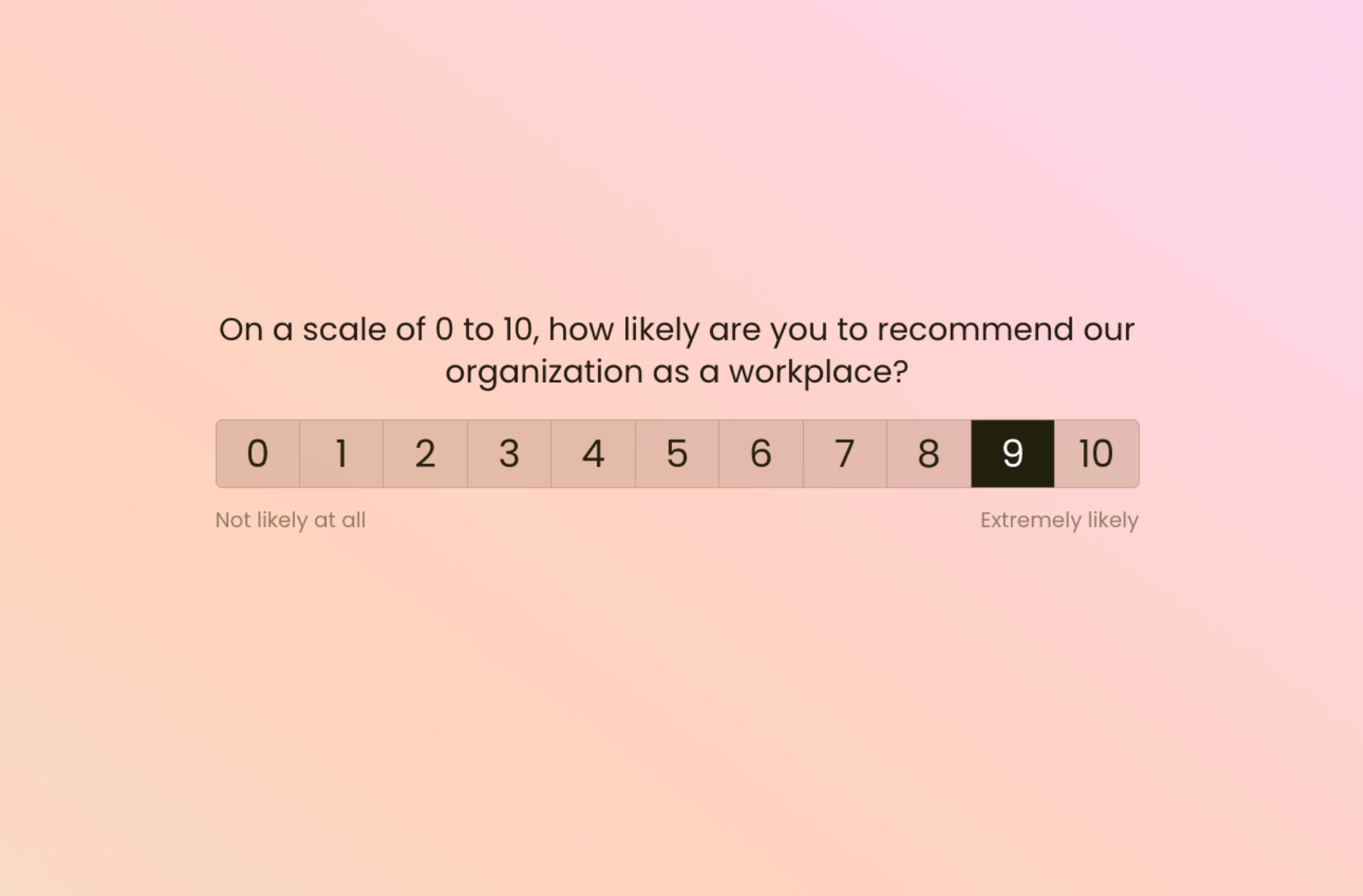
| eNPS | Willingness to recommend the company as a workplace | % Promoters (9–10) − % Detractors (0–6) | Quarterly, as a fast pulse |
| Employee satisfaction (eSAT) | Contentment with the job and environment | Average rating on a 1–5 scale | Alongside the annual survey |
| Voluntary turnover | How many people leave by choice | Voluntary exits / average headcount × 100 | Monthly or quarterly |
| Time to productivity | Effectiveness of onboarding | Days from start date to full autonomy | After every hire |
| Internal mobility rate | Whether growth paths actually exist | Roles filled internally / roles filled × 100 | Annually |
| Response rate | Trust in the listening program itself | Responses / invitations sent | Every survey |
The eNPS formula is identical to Net Promoter Score for customers—only the question changes to recommending the company as a place to work:
Benchmarks are useful but secondary. A single score tells you little; the value appears in the trend and in the comparison between teams. A drop in one department while the rest of the company holds steady is a far stronger signal than the absolute number. Read our eNPS guide for question wording and scoring detail, and our guide on measuring and improving employee satisfaction for the eSAT side.
Common Employee Experience Mistakes
Avoid these pitfalls that undermine EX efforts:
1. Treating EX as an HR Initiative Only
EX spans every function—IT, facilities, operations, and leadership must be involved.
Solution: Create cross-functional EX teams with executive sponsorship.
2. Survey Fatigue Without Action
Asking for feedback but never acting on it destroys trust.
Solution: Close the loop by communicating what you heard and what you’re doing about it.
3. One-Size-Fits-All Approach
Different employees have different needs based on role, tenure, and life stage.
Solution: Segment your workforce and personalize experiences where possible.
4. Ignoring Manager Experience
Managers can’t create great experiences for their teams if they’re struggling themselves.
Solution: Invest equally in manager experience and support.
5. Focusing Only on Perks
Free snacks and ping pong tables don’t compensate for poor management or lack of growth.
Solution: Focus on fundamentals first—purpose, growth, recognition, and belonging.
6. Neglecting Remote and Hybrid Workers
Out of sight shouldn’t mean out of mind.
Solution: Design experiences that work equally well for in-office, remote, and hybrid employees.
Technology and Tools for Employee Experience
The right technology enables scalable EX excellence:
Employee Feedback Platforms
A modern employee feedback platform like Responsly helps you:
- Create and distribute employee surveys across email, SMS, WhatsApp, and links
- Collect real-time feedback through pulse surveys
- Track eNPS quarter over quarter with an employee NPS survey tool that breaks the score down by team
- Analyze engagement trends over time
- Enable anonymous feedback
- Trigger alerts for concerning responses
See how HR teams bring eNPS, pulse, and engagement programs together in one platform, browse ready-made forms in our HR survey templates, or explore employee experience platforms for more options.
AI-Powered Feedback Analysis (the stage-4 layer)
This is the piece that moves you from “we run surveys” to “we act on feedback in real time.” The hardest part of employee experience at scale isn’t collecting responses—it’s reading thousands of open-ended comments before the signal goes stale. Responsly’s AI agent, Athena, analyzes open-ended eNPS and pulse responses to surface recurring themes, flag emerging risks (like frustration clusters that often precede resignations), and turn raw verbatims into a summarized report managers can act on. Instead of one person manually tagging comments for a week, you get the “what” and the “why” behind your scores in minutes—so the loop between listening and fixing closes fast enough to actually change outcomes.
The Rest of the Stack
Everything else supports the same goal—removing friction from daily work. An HRIS with real self-service handles time off, benefits, and payroll without an email chain. Collaboration and messaging tools keep distributed teams connected. Recognition platforms make appreciation visible rather than private. Learning systems keep development accessible. None of these fixes a broken culture on its own, but each one removes a recurring irritation that surveys will otherwise surface every quarter.
Where Employee Experience Is Heading
Three shifts are worth planning for:
- Wellbeing moves from perk to fundamental. Burnout prevention and mental health support are becoming part of the core EX program rather than an optional benefit. Read about managing employee stress and preventing burnout.
- Skills replace job titles. Organising talent around skills rather than fixed roles makes internal mobility easier and gives people more paths to grow without leaving.
- Listening becomes continuous and analysed by AI. Annual surveys give way to always-on feedback, and the constraint shifts from collecting responses to interpreting them fast enough to matter.
Getting Started: Your EX Action Plan
Ready to transform your employee experience? Here’s your action plan:
Week 1-2: Assess Your Current State
- Review existing employee feedback and metrics
- Conduct quick pulse survey on key EX areas
- Audit manager-to-team communication rhythm using a workplace communication checklist
- Map the current employee journey
- Identify top pain points
Week 3-4: Build Your Foundation
- Define your EX vision and principles
- Get leadership alignment and sponsorship
- Identify priority areas for improvement
- Set measurable goals
Month 2: Launch Your Listening Program
- Implement regular pulse surveys
- Set up dashboards to monitor metrics
- Create feedback loops for action
- Train managers on EX conversations
Month 3 and Beyond: Iterate and Improve
- Implement improvements based on feedback
- Measure impact and adjust
- Expand to additional EX areas
- Build continuous improvement culture
Conclusion
Employee experience is no longer a “nice to have”—it’s a strategic imperative that directly impacts business results. Organizations that invest in understanding their employees, designing meaningful journeys, and continuously improving will win the war for talent.
The good news? You don’t need to transform everything overnight. Start by listening to your employees, pick one area to improve, measure the results, and build from there. Small improvements compound into transformational change—and over time they help you build a high-performing culture.
Ready to elevate your employee experience? Create a free Responsly account and start collecting employee feedback today. Use our ready-made templates to launch eNPS, engagement, and pulse surveys in minutes.
FAQ
What is the difference between employee experience and employee engagement?
What is the difference between employee experience and employer branding?
How do you measure employee experience?
Why is employee experience important for business success?
What are the key components of employee experience?
Who owns employee experience in a company?
How often should you survey employees?
Tagged in
Last updated