Table of contents
- Why post-purchase surveys matter
- When to send a post-purchase survey
- What to measure: CSAT, NPS, or CES?
- Post-purchase survey questions (with examples)
- Choosing the right channel for post-purchase feedback
- Post-purchase survey best practices
- How Responsly helps you run post-purchase surveys
- Conclusion and next steps
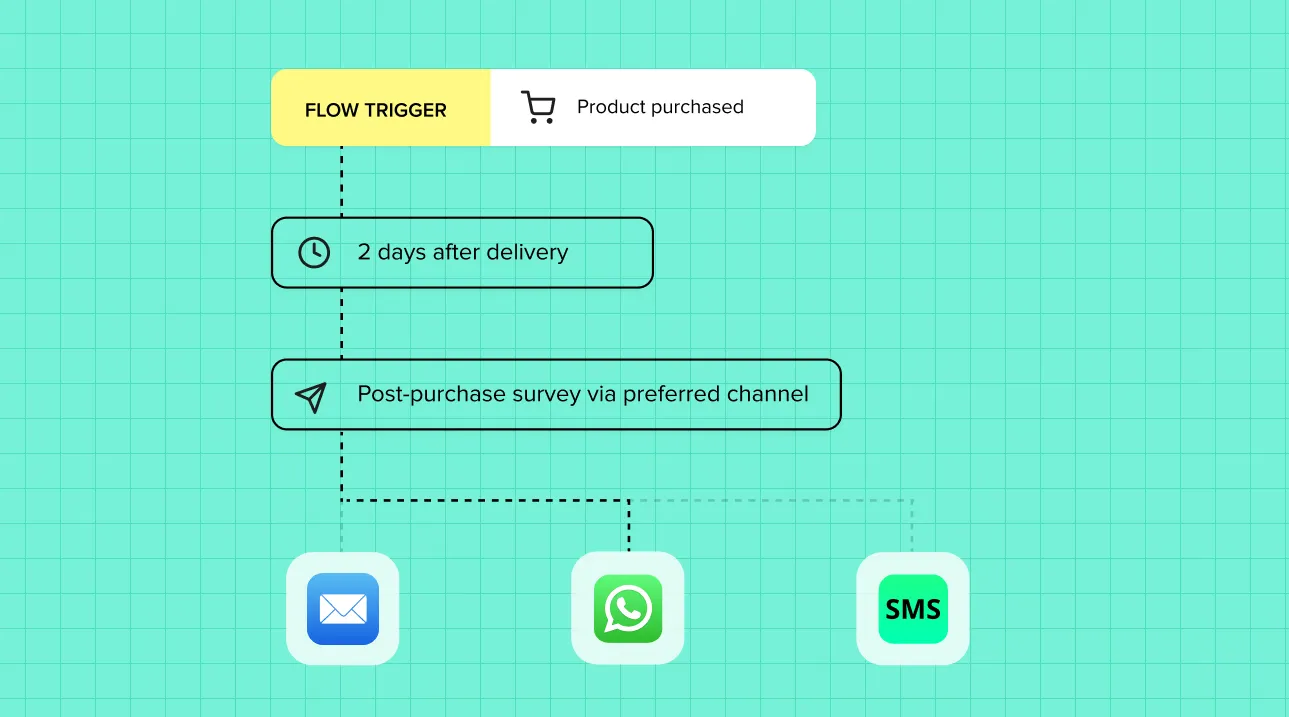
A post-purchase survey is a short questionnaire sent right after a customer completes a purchase to measure their satisfaction with the buying experience, product, and delivery. This guide is for e-commerce, retail, and subscription teams who want feedback that drives repeat sales—not survey fatigue. Pair surveys with payment integrations when you collect paid orders or donations—for example, trigger a survey from Shopify after an order ships, or fire a Facebook Pixel event to retarget respondents by satisfaction. You’ll learn the best moment to ask, which metric to use (CSAT, NPS, or CES), the exact post-purchase survey questions to copy, how to pick the right channel, and the mistakes that quietly kill your response rate. Throughout, we tie each step to the broader set of customer service metrics you should already be tracking.
Why post-purchase surveys matter
The checkout button is not the finish line—it’s the start of the relationship. A post-purchase survey captures intent and emotion while the experience is still fresh, which is exactly when feedback is most accurate and most actionable.
Done well, post-purchase feedback helps you:
- Recover at-risk customers fast. A low score triggers a follow-up before a frustrated buyer leaves a public review or requests a refund.
- Find friction in the funnel. Confusing shipping options, surprise costs, or a clunky checkout show up in the data long before they show up in your conversion rate.
- Increase repeat purchase rate. Asking for feedback signals that you care, and the insight lets you fix the issues that drive churn.
- Fuel product and merchandising decisions. Aggregated responses reveal which products delight and which generate returns.
This sits at the heart of a healthy customer journey, where every stage—from discovery to delivery—is measured and improved.
When to send a post-purchase survey
Timing is the single biggest driver of both response rate and data quality. The mistake most teams make is sending one generic survey at one moment. Different parts of the purchase deserve different timing.
| Survey focus | When to send | Best metric | Why this timing |
|---|---|---|---|
| Checkout experience | Immediately after order confirmation | CES | The process is fresh; you capture friction before memory fades. |
| Delivery experience | 1–2 days after the package arrives | CSAT | Customer can judge speed, packaging, and accuracy. |
| Product satisfaction | 1–4 weeks after delivery | CSAT / star rating | Enough time to actually use the product. |
| Overall loyalty | 2–4 weeks after first purchase | NPS | Loyalty is a relationship metric, not a transactional one. |
| Returns / refunds | Right after a return is processed | CES | Reveals how painful (or smooth) your returns flow is. |
The rule of thumb: ask about an experience only after the customer has had it. Surveying product quality the second someone clicks “buy” produces noise, not insight.
What to measure: CSAT, NPS, or CES?
Each metric answers a different question. Strong post-purchase programs combine two or three across the timeline above rather than relying on a single number.
- CSAT (Customer Satisfaction Score) — best for transactional moments like delivery or product quality. “How satisfied were you with your order?”
- NPS (Net Promoter Score) — best for measuring loyalty and predicting repeat purchases once the relationship has formed. New to it? See how to calculate NPS.
- CES (Customer Effort Score) — best for checkout and returns, where ease is the deciding factor.
Post-purchase measurement only works when the survey fires off an order event rather than a weekly send, which is what the CSAT and CES measurement pages are built around.
For example, CSAT is a simple percentage of positive responses:
If 180 of 220 respondents rate their order 4 or 5 out of 5, your post-purchase CSAT is roughly 82%. Track that number by product, channel, and shipping region to find exactly where experience breaks down. For the full formulas and benchmarks behind each score, see our guide to customer service metrics.
Post-purchase survey questions (with examples)
Keep every survey to 3–5 questions. Lead with the core metric, add one or two diagnostic questions, and always finish with one open-ended question—the comments are where the real insight lives. For more inspiration, see our library of the best customer satisfaction survey questions.
Checkout and ordering experience
- “How easy was it to complete your purchase today?” (1–7 effort scale)
- “Was there anything that almost stopped you from completing your order?”
- “Did you find all the payment and shipping options you needed?”
Delivery and packaging
- “How satisfied were you with the delivery speed?” (1–5)
- “Did your order arrive in good condition?” (Yes / No)
- “How accurate was the delivery time estimate?”
Product satisfaction
- “How satisfied are you with your purchase?” (1–5 star rating)
- “How well does the product match the description on our site?”
- “How likely are you to buy this product again?”
Loyalty and advocacy
- “On a scale of 0–10, how likely are you to recommend us to a friend or colleague?” (NPS)
- “What is the main reason for your score?” (open-ended)
The one question to never skip
End with an open-ended prompt: “What is the one thing we could do to improve your next order?” This single question surfaces issues your structured questions never anticipated—and modern feedback platforms can summarize hundreds of these answers automatically.
Choosing the right channel for post-purchase feedback
Where you ask matters as much as what you ask. The best channel depends on your audience, the moment, and how quickly you need a response.
| Channel | Reach | Best timing | Why choose it |
|---|---|---|---|
| Order confirmation page | High (captures everyone) | Immediately after checkout | Single-click CES while attention is highest. |
| Email survey | Broad | Delivery + product stages | Familiar, supports embedded first-click questions. |
| SMS / WhatsApp | Very high open rates | Delivery confirmation | Fast, mobile-first, ideal for short CSAT/NPS. |
| Website widget | Returning visitors | Next visit after purchase | Contextual, non-intrusive micro-feedback. |
| QR code on receipt or packaging | Offline + retail | In the box or at the till | Bridges physical purchases to digital feedback. |
A strong program uses more than one: an embedded email question for delivery, a WhatsApp CSAT for fast turnaround, and a QR code on the packaging for offline buyers. For a full breakdown of options, see our overview of survey distribution channels.
Post-purchase survey best practices
- Embed the first question. Let customers answer the opening rating directly in the email or on the confirmation page; sending them to a long external form kills completion. Our free customer feedback email generator builds ready-to-send CSAT and NPS emails with the first question embedded as one-click ratings.
- Personalize with order data. Reference the actual product and order number so the survey feels relevant, not robotic.
- Reward completion. A small thank-you lifts response rates—you can show a unique discount coupon on the end page after someone finishes the survey.
- Close the loop. Route low scores to support automatically and follow up. A closed feedback loop is what turns a detractor into a repeat buyer.
- Respect timing and frequency. Don’t survey the same customer after every micro-interaction. Cap how often a single buyer is asked.
- Act, then tell customers you acted. Sharing “you asked, we changed” updates builds trust and lifts future response rates.
Common mistakes to avoid
- Asking about a product before the customer has received it.
- Twenty-question surveys disguised as “quick feedback.”
- Ignoring open-text comments because they’re “hard to analyze.”
- Measuring scores but never assigning an owner to act on them.
How Responsly helps you run post-purchase surveys
Responsly is an AI-powered customer feedback platform built to collect non-annoying feedback across every channel your buyers actually use. For post-purchase programs, that means:
- Omnichannel distribution: trigger surveys via email, SMS, WhatsApp, website widgets, or QR codes on packaging—all from one place.
- Ready-made templates: launch in minutes with a customer satisfaction survey or NPS template, then customize to your brand.
- Automation and integrations: connect your store or helpdesk so a completed order automatically fires the right survey at the right moment.
- AI analysis with Athena: Athena, Responsly’s AI agent, reads open-ended responses, surfaces recurring themes, and flags churn risk—so you act on patterns instead of reading every comment by hand.
You can explore the full set of capabilities on the feedback collection hub or browse the customer feedback templates library.
Conclusion and next steps
A post-purchase survey is one of the highest-leverage feedback tools you have: it catches problems while they’re fixable, predicts repeat purchases, and feeds product decisions with real customer language. Keep surveys short, match the timing to the experience you’re measuring, pick the metric that fits the moment, and—most importantly—act on what you learn.
Ready to launch your first one? Start with a customer satisfaction survey template, or create a free Responsly account and connect your store today. For the wider measurement picture, pair your post-purchase data with the complete guide to customer service metrics, the customer retention metrics that track repeat business, and proven customer retention strategies.
For deeper benchmarks on checkout friction and cart abandonment, the independent research from the Baymard Institute is an excellent, non-commercial source.
FAQ
What is a post-purchase survey?
When should you send a post-purchase survey?
What questions should a post-purchase survey ask?
What is a good response rate for a post-purchase survey?
Tagged in
Last updated