All posts
Karol Koronowicz
Human Experience Specialist

 9 min read

Questions impact the success of your survey. We create questions by first selecting the question type, which has two characteristics: the form of introduction and presentation. Depending on the needs, we select the appropriate type.
Survey questions can use either a closed-ended or open-ended format to collect answers from individuals. And you can use them to gather feedback from a host of different audiences, including your customers and colleagues.
Types of Questions in Surveys
The online survey has changed the perception of survey questions. A different way of displaying and responding meant that traditional paper surveys were put aside. The new online forms opened a wide path of possibilities to improve the survey filling process. Questionnaires are no longer black and white printouts but colorful elements the respondent interacts with.
The distractions we observe today make the time spent on filling out questionnaires and forms very short. A variety of questions is needed to conduct a good survey.
Pro Tip: Using a variety of question types keeps respondents engaged and reduces survey fatigue, leading to higher completion rates.
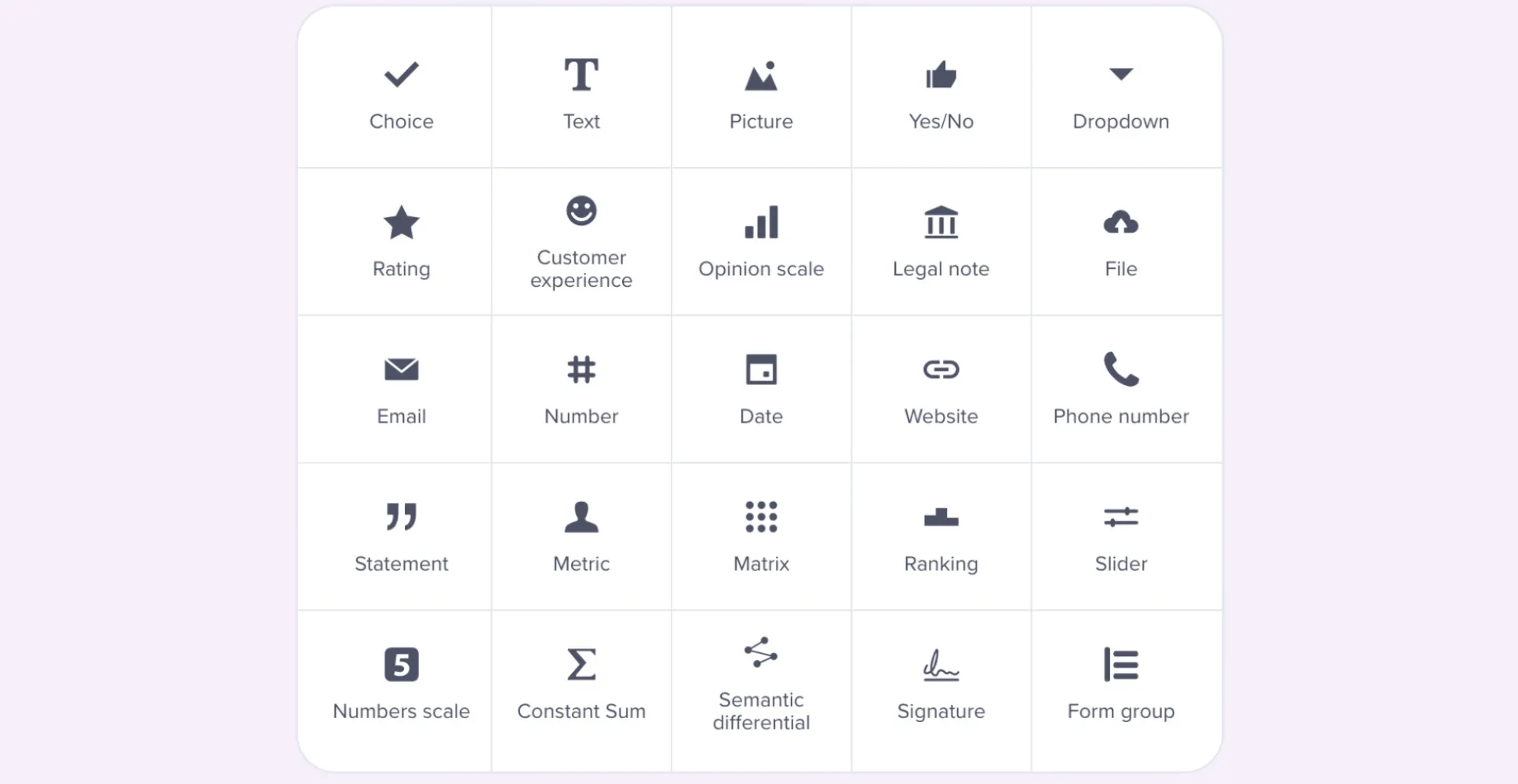
Responsly platform has 25+ types of questions. Such a selection allows you to conduct even the most advanced research. With our AI survey generator, you can automatically generate the most appropriate question types for your research goal.
Essential Survey Question Types
Multiple Choice
Multiple choice questions provide respondents with a list of options, and they can select single or multiple answers based on their preferences. Also known as closed-ended questions.
Best Practices:
- Clearly indicate if respondents can select multiple answers
- Consider limiting the minimum and maximum number of options
- Include “Other” option when appropriate
Open-Ended Questions
Open-ended questions allow respondents to provide detailed, free-form responses. They’re perfect for capturing rich, qualitative insights and uncovering valuable perspectives from your audience.
Example: “What features would you like to see in our upcoming product release?”
Best Practices:
- Keep questions clear and specific to elicit relevant responses
- Avoid asking too many open-ended questions to prevent respondent fatigue
- Analyze and categorize responses systematically
Likert Scale
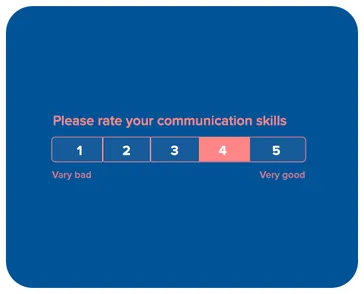
A Likert scale is a choice of 5 answers with one central and two extremes. We recommend graphical assessment questions with answers presented as smileys and animated emoticons for better engagement.
Example Scale:
- Strongly Disagree
- Disagree
- Neutral
- Agree
- Strongly Agree
Picture Choice
Picture choice questions use visual elements or images as answer options. These are particularly useful when dealing with audiences who may have language barriers or when exploring visual preferences.
Yes/No Questions
If you expect a yes/no answer, present it graphically with icons corresponding to the Yes or No answers. This type of question is very readable and will increase your survey response rates.
Dropdown
Presents a list of options in a dropdown menu, and respondents can select one choice from the list. Ideal for long lists of options like countries or job titles.
Rating Scale
Asks respondents to rate something on a scale, usually ranging from 1 to 5 or 1 to 10. Great for Likert scale questions and measuring satisfaction.
Smiley Rating
Uses smiley faces to represent different levels of satisfaction or emotions. Respondents choose the appropriate smiley, making it intuitive and engaging.
Opinion Scale (NPS)
Net Promoter Score (NPS) questions measure customer loyalty and satisfaction by asking respondents to rate their likelihood of recommending a product or service on a 0-10 scale.
Matrix Questions
Organizes questions and options in a grid format, allowing respondents to provide multiple responses at once. Efficient for comparing ratings across multiple items.
Ranking Questions
With ranking questions, you can define the preferences of your survey participants by arranging specific properties in preferred order. This is done using drag-and-drop, where selected properties are transferred to the order area with one click.
Benefits:
- Easy and ergonomic to use
- Dramatically increases response rate
- Average ranking calculated for each answer choice
Slider Questions
Sliders are engaging and interactive survey questions. The respondent clicks a button and drags it along a horizontal line, indicating their positive or negative feelings about a specific statement.
Best Practices:
- Use a straightforward scale with clearly labeled endpoints
- Avoid using too many sliders to prevent fatigue
- Provide clear statements that correspond to the slider’s purpose
Constant Sum (Distribution of Points)
The breakdown of points is handy when respondents have to assign appropriate values to given questions. The survey owner can set the total sum of points to be distributed across all options.
Best Practices:
- Provide clear instructions on how to distribute points
- Set a specific total sum for consistency
- Conduct a pretest to ensure accuracy
Semantic Differential
Asks respondents to rate a concept or item based on a series of bipolar adjectives or phrases (e.g., “like-dislike,” “satisfied-dissatisfied”).
This question type is mainly used in questionnaires and surveys to obtain emotional responses or attitudes to specific topics and evaluate products, services, brands, or organizations.
Demographic Questions
Used to collect information about socio-demographic characteristics. Collecting such data helps you understand your audience better and contextualize their answers. Demographic questions have predefined response options.
Additional Question Types
- Legal Note: Presents legal statements requiring acceptance
- File Upload: Allows respondents to upload documents or images
- Email: Collects email addresses
- Number: Requests numeric values
- Date: Uses a date picker
- Website: Collects URLs
- Phone Number: Collects contact numbers
- Form Group: Combines related questions
- Signature: Captures digital signatures
Key Insight: The right mix of question types can significantly improve data quality. Use closed-ended questions for quantifiable data and open-ended questions for context and depth.
How to Choose the Right Question Type
Selecting the correct question type is crucial for getting actionable data. Use this comparison table to guide your decision:
| Question Type | Best Used For | Data Type | Pros | Cons |
|---|---|---|---|---|
| Multiple Choice | Gathering specific data points | Quantitative | Easy to analyze, quick for respondents | Limits detail, options must be comprehensive |
| Open-Ended | Detailed feedback & insights | Qualitative | Rich detail, uncovers new ideas | Hard to analyze, higher effort for users |
| Likert Scale | Measuring attitudes & opinions | Quantitative | Standardized, easy to compare | Can suffer from central tendency bias |
| NPS | Measuring loyalty & growth | Quantitative | Industry standard, simple metric | Doesn’t explain “why” without follow-up |
| Matrix | Comparing multiple items | Quantitative | Efficient space usage | Can be overwhelming on mobile |
| Ranking | Determining preferences | Quantitative | Forces trade-offs, clear priorities | Cognitive load is higher |
Survey Questions for Customers
Customer surveys are the most direct way to gather constructive feedback from people who know the strengths and weaknesses of your products and services.
10 recommended customer feedback questions:
- How would you describe yourself in one sentence?
- What is your main goal for using this website/product?
- What, if anything, is preventing you from achieving that goal?
- What is your most significant concern about [product/brand]?
- What changed for you after you started using our product?
- How would you describe the buying experience?
- Do you feel our [product or service] is worth the cost?
- What convinced you to buy the product?
- What challenges are you trying to solve?
- What’s the ONE thing our website is missing?
Survey Questions for Employees
Employee surveys are integral elements of getting employee feedback to gain perspective on work culture, immediate superiors, and elements that motivate or demotivate employees.
Employee Questions About Personal Growth
- What are your career goals?
- Have you interviewed for another job in the past two months?
- Have you accomplished any career goals in the last six months?
- On a scale of 1 to 10, how challenged are you daily at work?
- What motivates you to go above and beyond at work?
Employee Questions About the Company
- If you were to leave tomorrow, what would the reason(s) be?
- Without looking anywhere else, please recite our organizational values.
- Are you proud to work for our organization? Why?
- If your organization had a theme song, what would it be and why?
Employee Questions About Management
- Has a manager given you recognition in the past month?
- How cohesive is the management team on a scale of 1 to 10?
- How respected do you feel by your direct supervisor?
- How transparent is the management team?
- Name three processes we can improve and explain how.
Employee Questions About Work Environment
- Name three perks you liked best about your previous employer.
- How connected do you feel with your coworkers (1-10)?
- Describe our culture in one word. Add an explanation.
- Rate your onboarding experience (1-10).
- Do you have the resources you need to be successful?
Survey Questions After Events
Event and conference surveys are a great way to capture attendee feedback. 90% of virtual event organizers use surveys to measure attendee satisfaction, and 80% reported that engagement and satisfaction were KPIs for measuring event success.
Best post-event survey questions:
- How satisfied were you with the event?
- Why did you attend this event?
- How did you hear about this event?
- Would you attend this event again in the future?
- Have you attended our other events before?
- What were your favorite features?
- How easy to navigate was the platform?
- How relevant was the content?
- How would you rate the speakers?
- Was the venue accessible?
Survey Questions for Online Sellers
Know what your buyers feel and gain actionable insights with eCommerce survey questions to increase sales. The best way to boost conversion is to ask customers, “How can we improve?”
General Overview Questions
- On a scale of 1-10, how likely are you to recommend us?
- How satisfied were you with your overall experience?
- How can we improve your experience?
Website Questions
- How did you learn about our website?
- What were you looking for?
- Did you find what you were looking for?
- Are you going to return later?
- How easy was it to navigate the site?
Product Review Questions
- How much do you trust the product reviews (0-10)?
- How helpful are ratings when making purchase decisions?
- How much does overall product rating affect your decision?
Post-Purchase Questions
- How satisfied are you with product quality?
- How do our products compare to competitors?
- How satisfied are you with product availability?
Customer Support Questions
- How was your experience with customer support (1-10)?
- Did the support executive solve your query?
- How helpful was the customer support staff?
Tip: Avoid asking too many questions—keep a mix of multiple-choice, open-ended, and closed-ended questions to maintain engagement.
Ready to create your survey? Create a free Responsly account and use our database of ready-made survey examples.