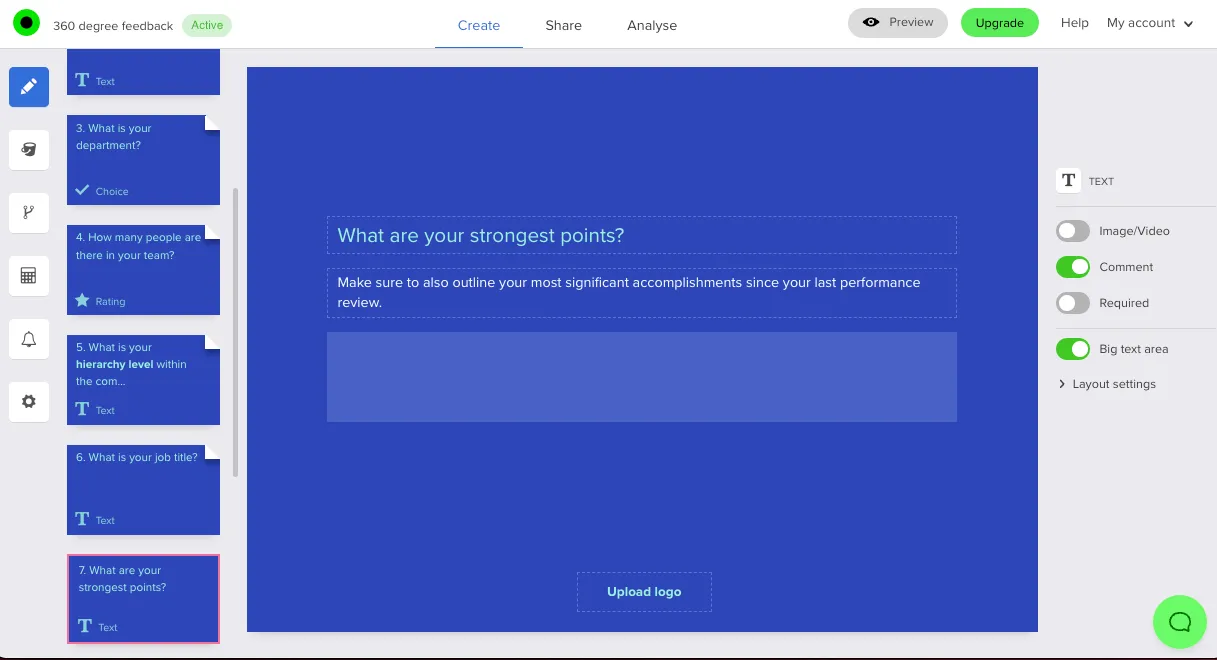
Free text questions (also called open-ended questions) let respondents type answers in their own words instead of choosing from preset options. That freedom is ideal when you need qualitative detail: motivations, wording customers use, edge cases, or ideas you did not list in a dropdown.
Use free text when you want to understand context behind ratings, investigate satisfaction or frustration, or explore needs and expectations beyond a template. Write prompts that invite useful detail while staying specific enough to answer.
Example prompts for qualitative insight
Examples can stand alone or follow a closed-ended question so people explain a score or choice.
Free text fits customer and employee satisfaction surveys, discovery interviews at scale, and any flow where verbatim language matters.
- Would you recommend our services to others? Give a reason.
Understanding why someone would or would not recommend you highlights strengths and blockers you might not guess from scores alone.
- What factors usually influence your purchase?
This style of prompt surfaces decision drivers your team may not have listed—useful for improving positioning, packaging, or support content.
Pair open-ended questions with closed-ended ones
Open fields alone do not always pull rich comments. You can use required questions where a short explanation is essential—but avoid too many long blank fields in one form, or completion rates can drop.
A single well-placed free text box often yields deeper answers than several generic “Any comments?” fields.
Closed-ended questions keep analysis simple: you can view counts, percentages, and charts in real time. Free text adds the why behind those charts. For analysis habits after collection, see How to analyze survey data.
Wording and layout in the editor
Make prompts easy to read: use text formatting (bold, links, short lists) in the question text so instructions stand out without clutter.
Free text question in a survey