The semantic differential captures attitudes and emotional reactions toward a topic, product, service, brand, or organization using a bipolar scale: respondents place themselves between two opposite meanings on the same line.
Anchors and middle points
Typically the scale runs between opposite adjectives, for example:
- “like – not like”,
- “satisfied – dissatisfied”,
- “would recommend – would not recommend”.
Between the poles you add intermediate options so people can express degree without open text.
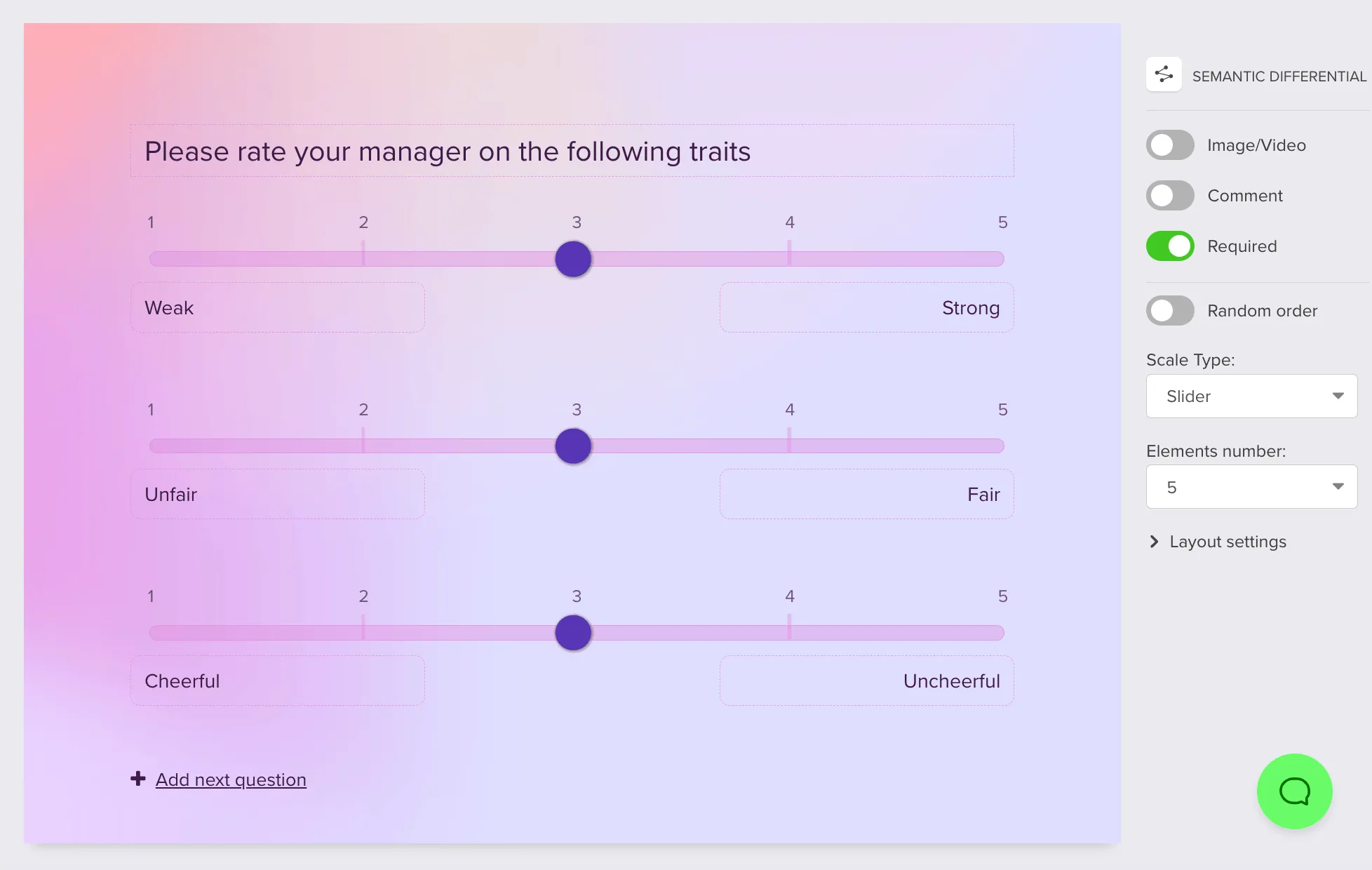
Compare to other scale types
- Numerical scale — discrete numeric options, often with numbered endpoints.
- Slider questions — continuous or long-range drag along one dimension.
Semantic differential is a strong fit when paired adjectives are part of your methodology and you want comparable brand or experience tracks over time. To reduce order and wording bias, keep anchors balanced and consider guidance in Survey response bias.
FAQ
What is a semantic differential scale?
It is a rating line anchored by opposite adjectives at each end—such as satisfied versus dissatisfied—with intermediate points for degrees in between. It measures attitude or perception on one dimension per row.
How is semantic differential different from a numerical scale?
Both can produce numeric data, but semantic differential emphasizes opposite word pairs at the poles. Numerical scales often use numbers or Likert labels without forcing paired adjectives—see Numerical scale question.
When use semantic differential instead of a slider?
Use semantic differential when bipolar word pairs match your research tradition (brand perception, UX). Sliders suit continuous feel or long ranges where dragging is clearer than discrete adjective steps.