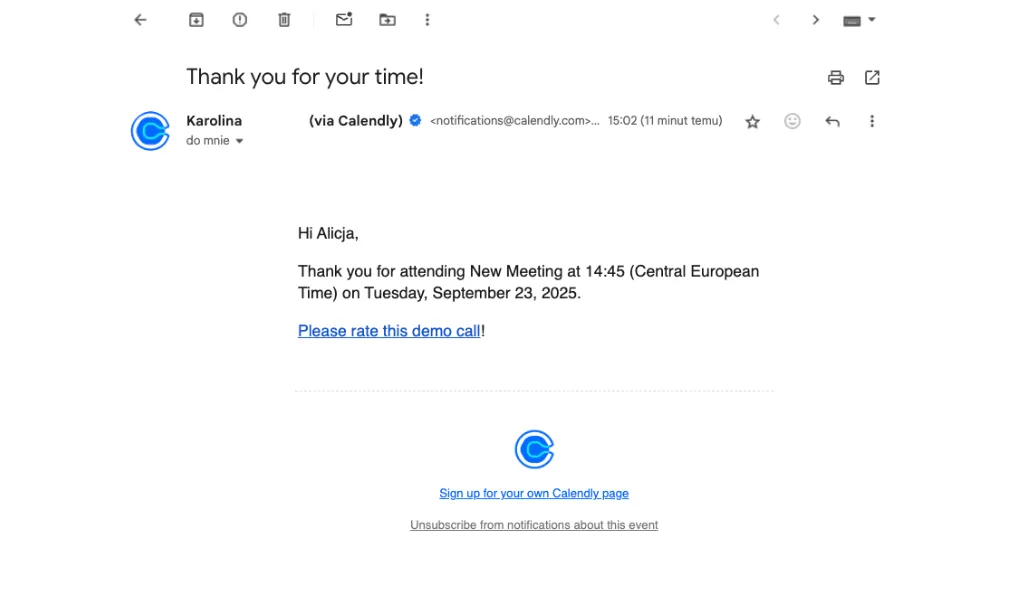
Integrating Responsly with Calendly lets you automatically collect feedback right after someone books or attends a meeting.
This helps you measure the quality of meetings, demos, consultations or onboarding sessions — without manual effort.
By passing hidden variables (like the booker’s email address) through the survey link, you can:
- identify who submitted the survey without asking for their details,
- track feedback by meeting type or host,
- automate the feedback loop: surveys are sent via Calendly follow‑up emails and results appear instantly in Responsly.
This guide takes about 5 minutes to complete.
Before you begin
Make sure you have:
- a Responsly account with permission to create surveys,
- a Calendly account with access to Workflows and Email Follow‑ups,
- the ability to use tokens in Calendly (for example
{{invitee.email}}).
Step 1. Create your survey in Responsly
- Log in to your Responsly account.
- Create a new survey (use the Link distribution channel).
- Add your questions, logic and design as needed.
Step 2. Add a hidden variable for the booker’s email
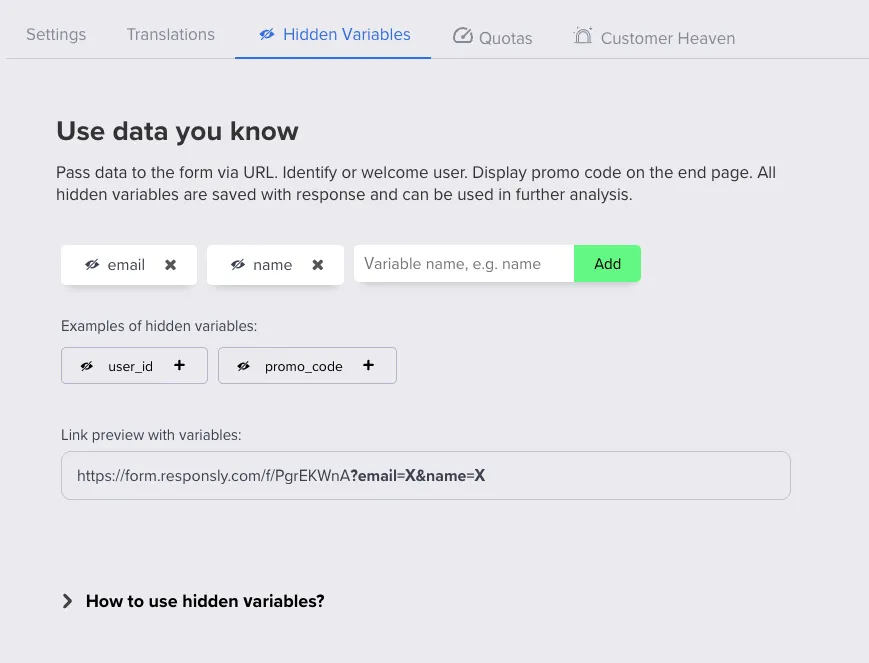
- In your survey, go to Settings → Hidden variables.
- Click Add hidden variable.
- Enter a name for your variable, e.g.
email. - Save the changes.
You can add more variables if needed (e.g.
name,meeting_type,id).
They’re not shown in the survey but are saved with each response.
Step 3. Copy a link with hidden variable placeholders
When you add hidden variables, copy the survey link.
Example base link:
https://yourcompany.responsly.com/s/abcd1234Calendly lets you insert placeholders (tokens) such as the invitee’s email. Use this format:
https://yourcompany.responsly.com/s/abcd1234?email={{invitee.email}}You can add multiple variables if needed:
...?email={{invitee.email}}&name={{invitee.first_name}}%20{{invitee.last_name}}Calendly automatically replaces {{invitee.email}} with the real email of the person booking.
Step 4. Add the survey link to Calendly follow‑up emails
- Log in to Calendly.
- Go to Event Types and choose your event.
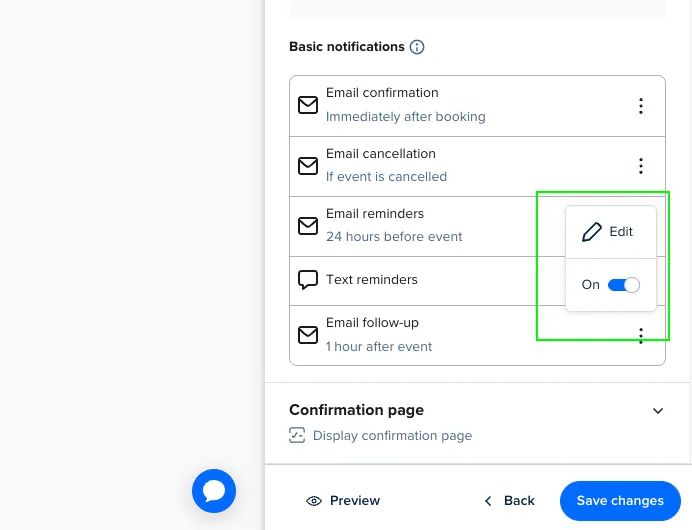
- Open Notifications and Workflows.
- Scroll to Email Follow‑ups.
- In the email body, paste your survey link with the variables.
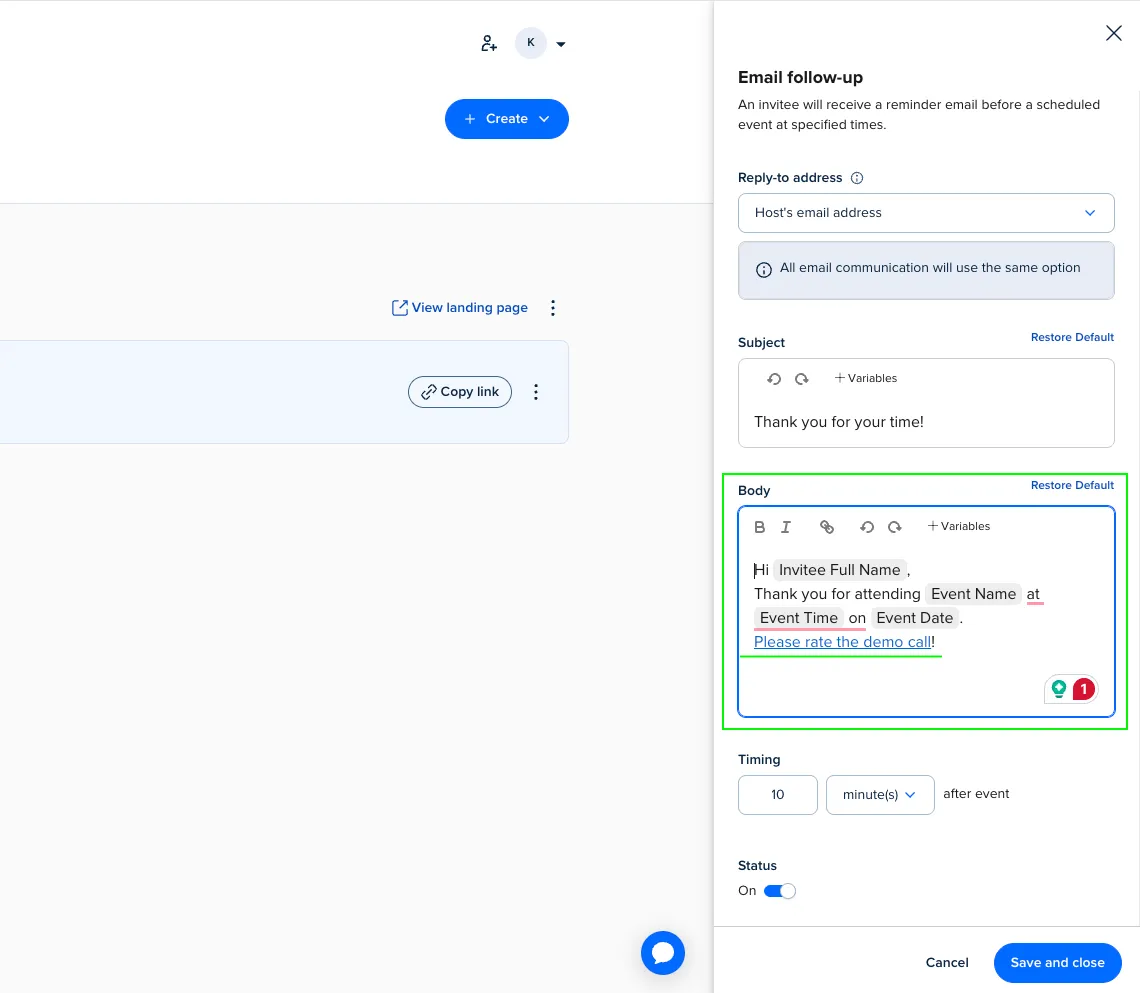
- Save your changes.
Step 5. Test the integration
- Book a test meeting in Calendly.
- Wait for the follow‑up email.
- Click the survey link and submit a response.
- In Responsly, confirm that the response includes the hidden variable
emailfilled with your test address.
Results
Every survey response will now contain the booker’s email automatically. You can:
- see who submitted which response,
- filter results by email or other passed‑through data,
- personalise survey content using
$emailor$nameplaceholders inside questions.
Related workflows
The Calendly integration covers the meeting-feedback programs this pattern supports — post-demo, post-consultation, and no-show follow-up. To route the answers onward as they arrive, see the Slack integration.